Photography backdrop stand fabric: wrinkles, storage and carry cases
Most of a photography backdrop's life is spent off the stand, folded in a case. How you fold it decides how it photographs.

Why creases show up on camera
A crease is a thin ridge, and a ridge lit from the side casts a thin shadow. That is all a visible wrinkle is. Which means the first fix is not an iron — it is moving the light. A key placed to the side of a backdrop rakes across the weave and prints every fold; the same light moved towards the camera axis, or bounced, flattens them out of existence.
The second fix is distance. Move the subject forward and let the background fall out of focus and out of the key light's throw, and a wrinkled grey becomes an even grey.
Getting creases out
Hang the fabric on the frame and leave it overnight if you have the time — gravity does most of the work on polyester and spandex. A handheld steamer, held a hand's width off the surface and run downward, does the rest in a few minutes. An iron works on cotton and muslin at a low setting with a cloth between, and should not go anywhere near a synthetic screen.
Do not wash a backdrop the night before a shoot expecting it to come out flat. Wash it the week before, hang it damp on the frame, and let it dry in place.
Folding and the carry case
Roll rather than fold where the case allows it. A rolled backdrop has one long curve instead of a grid of hard lines, and it recovers on the frame in minutes. Collapsible spring-hoop screens are the exception: they are designed to twist down into three rings and come out of the case flat, and forcing them into a square fold is what kills the hoop.
A carry case earns its place by being the thing that makes you take the background with you. Slim, with a shoulder strap, and long enough to take the crossbar sections without bending them.
Storing between jobs
Keep fabric off the floor and out of sunlight. A black backdrop stored in a bright room goes grey at the folds within a year, and the change is slow enough that you do not see it until you photograph against it. Keep the clamps in the same bag as the cloth so you never arrive with one and not the other.
Paper is different: store it upright on the roll and never flat. A roll of seamless left lying on its side develops a permanent oval that you can see in every sweep until the damaged section is cut off.
Carrying and storing an EMART photography backdrop stand
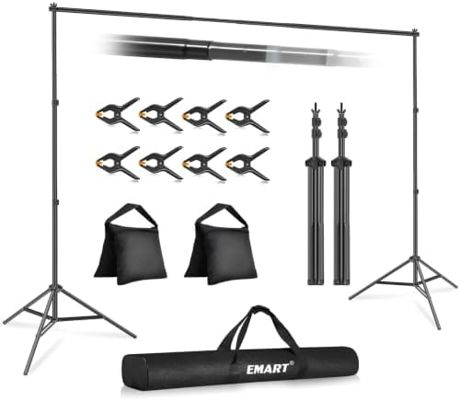
Gear like this is not broken by use, it is broken by transport. The package a frame arrives in is the one it will spend its life inside: a carry bag that takes the collapsible sections, the small parts and the extra clamps, compact and stable enough to carry in two hands. Folded, a support stand transports as one piece; unfolded it has to be stable, which is why the legs open wide and why weight at the feet matters more than weight in total. Position the base so nobody kicks a foot, keep the heavy part of the load over it, and the same frame will serve types of work that look unrelated — portraits, recorded interviews, pet photography, product photo work, weddings and an event booth — without needing anything else bought for it.
Choosing a surface for storage is choosing a material. A seamless white sweep, a black drape, a green panel and a muslin cloth all crease differently, and the professional answer is the dull one: roll rather than fold, keep the clamps in the same bag as the cloth, store everything out of sunlight. Aluminum alloy keeps the frame portable and is the popular choice for gear that travels; heavy metal gives enhanced durability where a rig stays put. Quality in a case is slim shape, a shoulder strap and a length that takes the crossbar sections without bending them. A standard mounting thread is essential so the frame assembles quickly out of the bag, and setup is faster when nothing had to be straightened first. Care is a wipe and a dry corner; practicality here is simply that an excellent, powerful specification photographs no better than a flat background.
Before you buy, in five lines
- Roll, do not fold, wherever the case allows it.
- Hang the cloth on the frame overnight and gravity does most of the work.
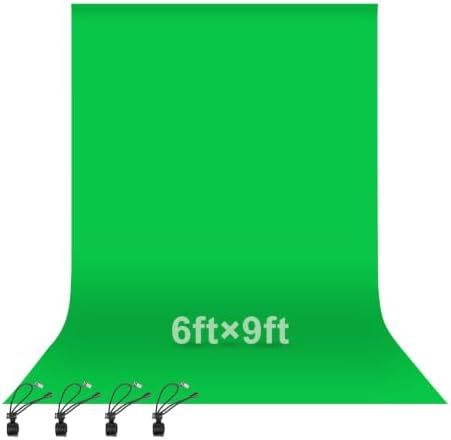
- Steam from a hand's width away; never put a hot iron on a synthetic chroma surface.
- Store paper upright on the roll, never flat on its side.
- Keep the clamps in the same bag as the fabric so you never arrive with one and not the other.
Asked between takes
How do you remove wrinkles from fabric backdrops?
Hang the fabric on the frame under its own weight for a few hours, then steam it from a hand's width away, working downward. Low-heat ironing with a cloth works for cotton and muslin but not for synthetic chroma key screens. Moving your key light away from a raking angle removes the appearance of wrinkles even when the wrinkles are still there.
How do you store and maintain backdrops to prevent damage?
Rolled, off the floor, out of direct sunlight, in the case it came in, with the clamps. Wash to the label, hang damp on the frame to dry, and never leave a roll of paper lying on its side.
Can a green screen be washed?
The polyester and spandex screens can, to the instructions on the listing. Wash cool, hang damp on the frame rather than tumble drying, and keep heat away from the surface — a shine on a chroma key screen is harder to grade out than a crease.