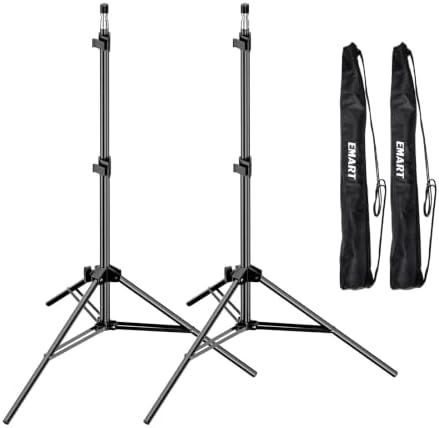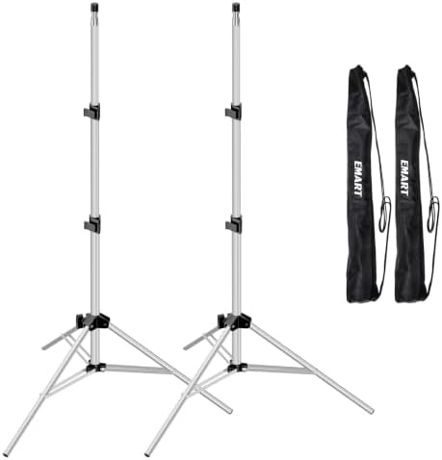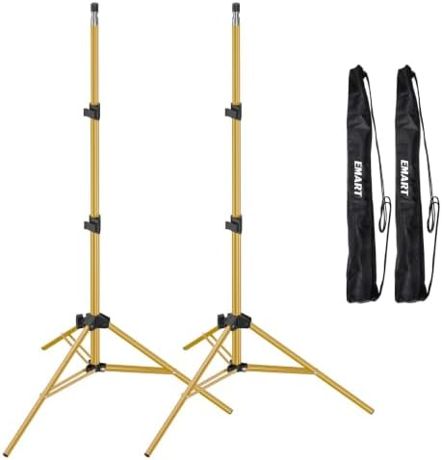
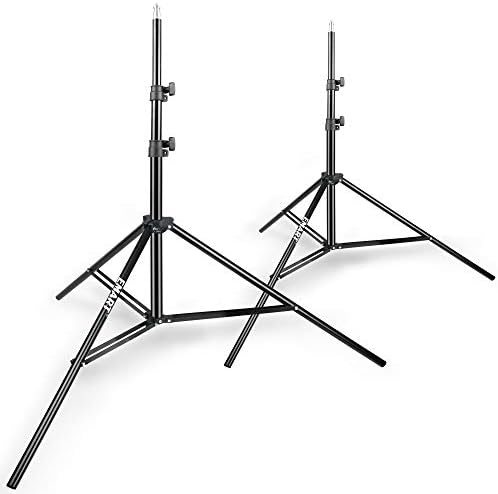
EMART 8.5 Ft Light Stand for Photography, Speedlight, Flash, Softbox-2 Pack
EMART gear: photography backdrop stands, background support, lighting and the small metal.
Portable Photo Video Lighting Tripod for Strobe, Camera, Selfie, Photographic Portrait
4.3 265 reviews
$3999
In Stock
We designed this one around the part of the job nobody photographs: the half hour before the first frame.
The frame is aluminium alloy, which is the difference between a stand that travels and one that bends. You also get a heavy-duty build and a portable format. We keep one listing per size so you are never guessing which box arrives.
Key features
- Professional light stand, making it strong for heavy duty work
- Made of aluminum alloy construction for durability
- Adjustable from 2.9ft to 8.5ft, max load capacity: 22lb
- Standard light stand mount for use with any light head, 1/4" screw tip on the stem
- The base fully spreads about 4.3 square feet, makes item to be more stable when you extend the top extension
Specification
| Material | Aluminium alloy |
|---|---|
| Reviews on the listing | 265 |
Where it sits in the range
EMART spring-cushioned light stands, heavy-duty C-stands with boom arms, reverse-folding tripods and phone stands for photography on location.
The job it does
A light stand is the part of a kit nobody thinks about until something expensive hits the floor. This is a support stand built to go high cheaply and stay stable while it is up there, which is a different job from a tripod — a tripod is built to hold something still and aim it.
Matching it to a photography backdrop stand
Work out the size from the room rather than from the catalogue. Measure the wall you shoot against, take a foot off each end for the legs, and what is left is the span a frame opens to and can honestly accommodate. Height is the figure people change their mind about later: seven feet suits a seated subject, while a standing full-length shot wants the frame fully expanded so the top edge of a seamless white, muslin, black or green surface stays out of shot. Space behind the subject matters as much as space across it — stood directly against the surface, anybody picks up its texture. In a small room, give yourself a little extra at the back so an additional panel or a prop can go in without everything having to move. As a general rule, choosing one size up costs less than choosing one size down.
Getting it standing
Assembly is quick and standard. Pull each telescopic section up by hand, lock the adjustable collar, square the base. The mounting threads are the usual size for this kind of gear, so a fitting borrowed from another stand will do, and the whole setup takes one pair of hands. The legs open wide, and that width is the stability — not the thickness of the tube. Position the base so nobody kicks a foot, and add weight at the feet whenever the load is heavy or people are moving across the room behind the frame.
Hanging it and holding it steady
Hang the surface a little narrower than the crossbar so it has something to pull against. A spring clamp secures each corner, hooks carry the middle, and that clamp will just as happily hold a light modifier or pin a cable to a tripod tube when the kit outgrows the room.
Travel, bag and care
Folded, it is compact enough to transport as one piece: the carry bag in the package takes the whole collapsible set, so no extra sections travel loose. The quality worth paying for is boring: metal collars that still grip, a design with no part that only works while new. Aluminum keeps a pro kit portable, heavier metal makes it durable, and durability on gear like this is an argument about joints. We would rather sound dull than claim an excellent finish. Keep it dry and the care budget is a cloth. Grit in a joint wears a section faster than rain does; a rolled surface arrives without a wrinkle, a folded one arrives with a map of itself.